Low-Code Isn't Replacing Developers. It's Changing What They Build
See where low-code fits — and where it doesn't — in your engineering stack.

Why use a Formula 1 driver to deliver groceries?
Yet that’s exactly what most organizations do when senior developers spend their days building forms, approval workflows, and simple integrations.
Low-code handles those tasks faster and at lower cost, freeing engineering talent for AI, competitive differentiation, and the complex problems no tool can automate.
The Ceiling Is Higher Than You Think
Low-code isn’t a junior version of software development. It’s a different tool for a different job.
You can go from idea to working Minimum Viable Product (MVP) in hours instead of weeks. A significant portion of what used to require a developer — APIs, integrations, internal workflows, data pipelines — doesn’t need heavy coding anymore. And increasingly, non-technical people can build things that previously required a dev team and a ticket queue.
The ceiling is higher than most executives assume. Production systems running entirely on no-code tools for years are no longer rare. The technology has matured. The question isn’t whether it works, it’s whether you’re deploying it strategically.
Who It’s Actually For
Low-code has most obviously benefited smaller organisations. If you need something automated but can’t justify a full engineering build, no-code can deliver a quality, long-term solution at a fraction of the cost and time. That’s real competitive value.
But the opportunity isn’t limited to resource-constrained teams.
A mid-sized logistics company recently automated its entire partner onboarding workflow — previously a two-week dev project — in three days using a no-code platform, with no engineering involvement after the initial setup.
For any organization, low-code absorbs the long tail of internal requests — the dashboards, the approval flows, the system glue — that would otherwise quietly drain your engineering capacity. When non-technical staff can ship features themselves, your developers stop being a bottleneck and start being a multiplier.
Where It Breaks Down and Why That Matters
Low-code breaks down predictably, in the same three places.
First, when the data model gets genuinely complex and relational. Second, when you need custom logic that the platform’s expression language can’t elegantly express. Third — and this is the one that catches teams off guard — when you need to debug something subtle that the visual interface obscures rather than reveals.
Debugging a visual workflow with 90 nodes is effectively printf debugging with more clicking. The tool doesn’t make the reasoning easier, just the syntax. The reasoning is still entirely human, still entirely the domain of an experienced developer.
Scaling, performance, and complex logic still need proper engineering.
That’s not a weakness of low-code — it’s a clear boundary that makes it easier to deploy correctly.
What Actually Changes for Your Engineering Team
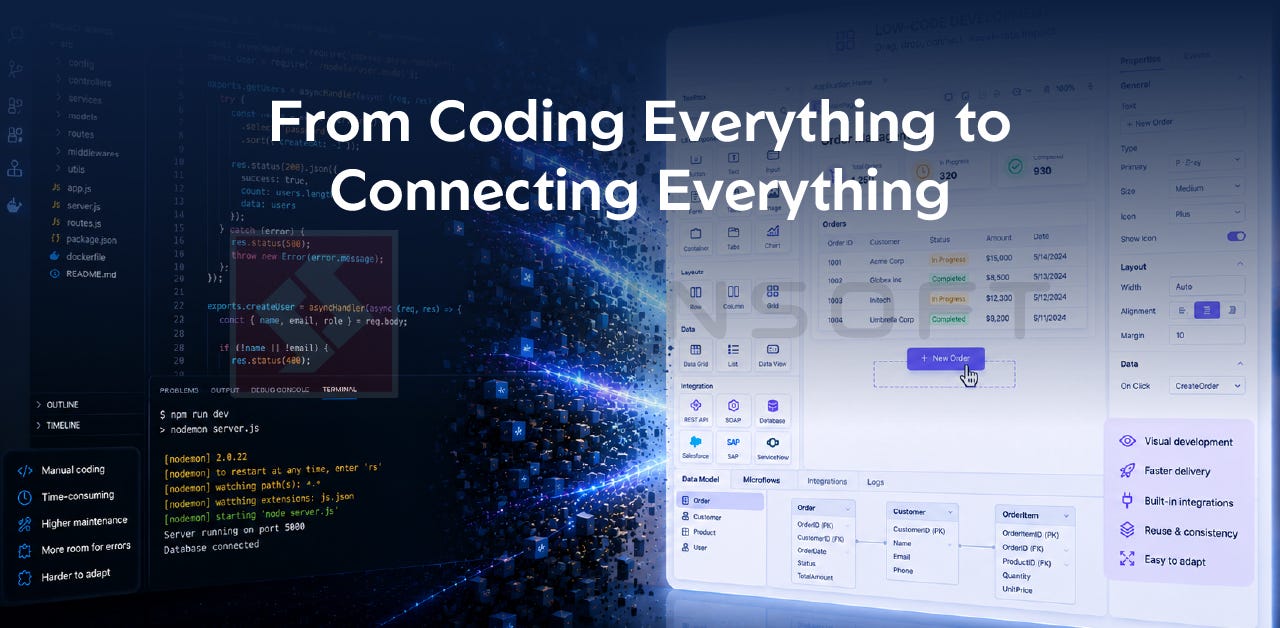
The real shift is from “How do I code this?” to “How do I connect this?”
The biggest change low-code brings isn’t in the tools. It’s in how developers think.
The move is from writing logic to orchestrating systems. That shift requires the same problem-solving instincts, the same understanding of data flow and edge cases — but the output looks different. A senior developer working in a low-code environment is still doing high-skill work. They’re just doing it at a different level of abstraction.
This matters for leadership because it means low-code doesn’t devalue your engineering talent. It redirects it. The developers who adapt well to this model become extraordinarily productive, capable of delivering across a wider surface area with less overhead.
The Governance Risk Nobody Mentions
More people building means more things that can break in ways no one anticipated.
As non-engineers begin shipping features, the burden on QA and testing increases. Validating what users actually see on screen, catching edge cases that a developer would have caught intuitively, ensuring stability as the builder population grows — these are real governance concerns. The organizations that get this right build lightweight review gates: simple checkpoints that keep quality stable without slowing the pace that made low-code worth adopting in the first place.
Low-code changes how things get built. It doesn’t remove the need for quality oversight. If anything, it raises it.
What This Means for Your Engineering Strategy
Low-code isn’t a threat to your development team. It’s a forcing function for clarity — clarity about what your best engineers should actually be working on.
The organizations getting this right are asking a simple question before any build: does this genuinely require an engineer? If the answer is no, they route it accordingly. If the answer is yes, their engineers can focus on work that compounds — AI, infrastructure, product differentiation, the systems that will matter in three years.
If you’re working out where to draw that line in your own organization, that’s exactly the kind of assessment SrinSoft Technologies specializes in helping enterprises deploy low-code strategically, not just opportunistically.
The F1 driver still drives. Just not to the grocery store.
Talk to SrinSoft
See where low-code fits — and where it doesn’t — in your engineering stack.